




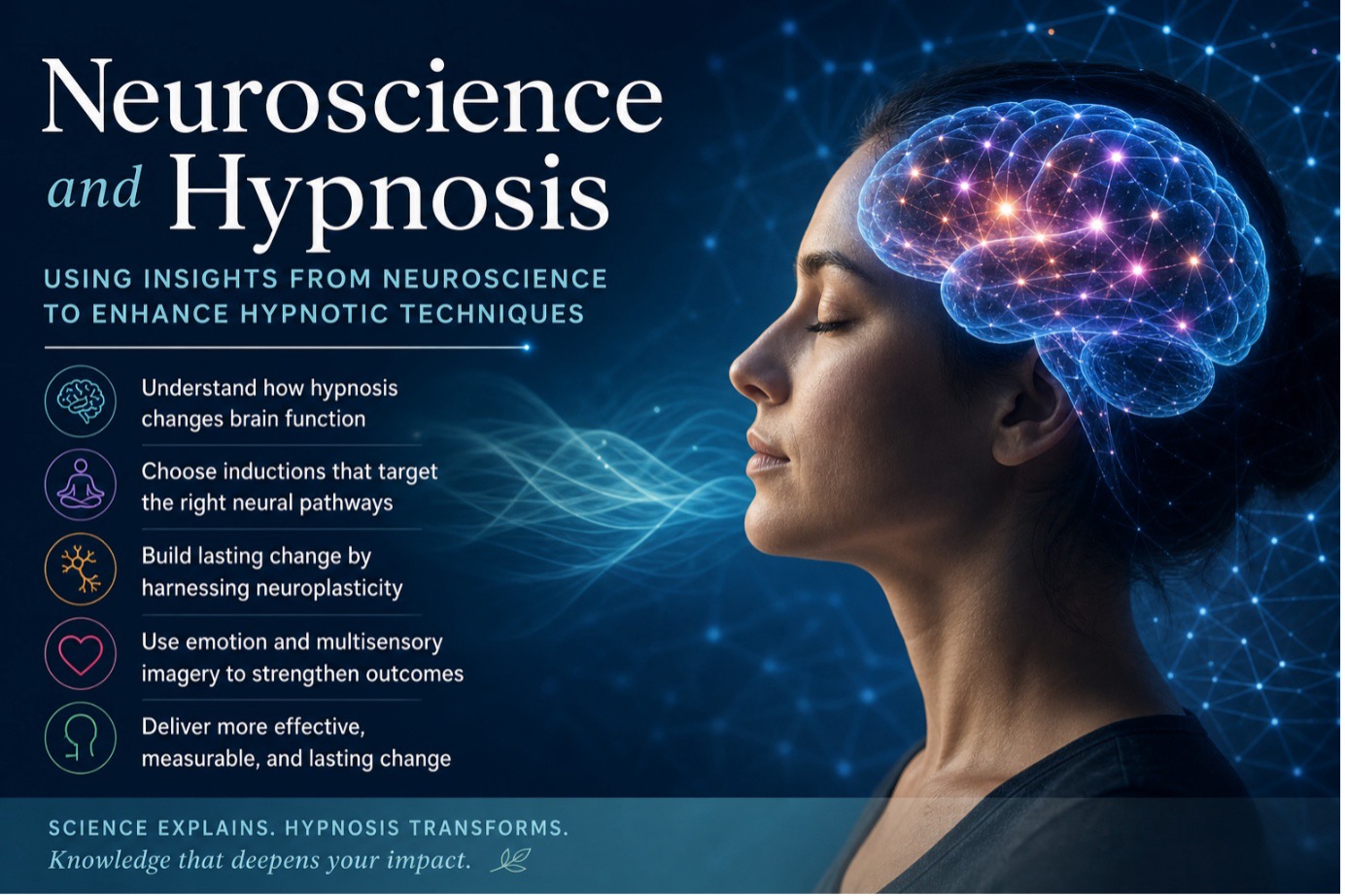
Neuroscience and Hypnosis
Using insights from neuroscience to enhance hypnotic techniques
In recent years, the partnership between neuroscience and hypnosis has evolved into a powerful way to explore how attention, imagination, and suggestion shape perception and behaviour. New discoveries about brain networks, learning, and emotion are refining how clinicians and practitioners use hypnosis.
Neuroscience has now confirmed that professional and directed hypnosis creates measurable, reversible shifts in brain function. The more we understand about this process, the more we can focus on using the patterns of connectivity we discover as a powerful tool for change.
Here is an example. Functional MRI and EEG studies show that during hypnosis, the brain networks involved in self‑monitoring, sensory processing, and emotional regulation behave differently. The mode associated with internal dialogue and self‑awareness, becomes quieter. Meanwhile, attention networks and executive control centres strengthen their communication. What we see is a brain highly engaged with the process of change yet less entangled in self‑critical thoughts. This is an ideal condition for therapeutic suggestion.
Designing hypnotic inductions with this knowledge of the brain
Different hypnotic induction methods, such as progressive relaxation, focused breathing, or eye fixation, affect different neural pathways. Progressive relaxation, for instance, reduces activity in the sympathetic nervous system and the limbic structures linked to stress, encouraging parasympathetic calm. This prepares the brain for heightened receptivity by lowering defensive arousal.
In contrast, focused‑attention inductions activate the anterior cingulate cortex (ACC), a region central to selective attention and conflict resolution. When a practitioner encourages a subject to concentrate on a single image, the ACC engages like a spotlight operator, filtering out distractions. Understanding these differences means hypnotherapists can choose inductions tailored to their client’s needs: relaxation‑based approaches for anxiety, attention‑intensifying ones for focus or performance.
Creating and building upon the neuroplastic brain
The concept of neuroplasticity — the brain’s capacity to rewire itself — connects directly with hypnosis. We now have evidence that suggestion under trance changes activity in the motor, sensory, and emotional regions of the brain. This can happen just with suggestion, even in the absence of external stimuli. When a client vividly imagines a desired behaviour or state, these brain regions change as if the experience was real.
A hypnotherapist who understands this can begin to design scripts that build on this new knowledge. For example, instead of merely instructing a client to “feel confident”, the therapist can get the client to imagine how they would behave if they were confident. They can encourage the client to use all their senses to model this confidence, how they stand, how they walk, how they speak and breathe, how they feel in their body. The richer this experience can be made, the more neural pathways are involved, strengthening the network that supports new behaviour.
This approach is similar to the cognitive rehearsal used by athletes and musicians before performance. And with hypnosis the focus deepens and reduces inner distraction, so it is even more powerful.
Tuning into Emotional Networks
Emotion has immense power to strengthen learning. Neuroscience shows that memory and motivation rely heavily on the limbic system, particularly the amygdala and hippocampus. When emotional arousal accompanies an event, these structures mark it as important, prompting longer‑term consolidation. We remember what we care about.
Hypnotherapists can use this knowledge deliberately. By embedding positive emotion — pride, relief, warmth, curiosity — into hypnotic imagery, they exploit the brain’s emotional tagging system. Suggestions then carry stronger motivational force because the limbic brain treats them as experiences worth remembering.
Integrating multisensory experience into therapy
Neuroscience shows us that the brain constructs experience using all senses to create a coherent sense of self. Effective hypnotic scripts use the fact that suggestions that involve more than one sensory channel produce stronger neural engagement than purely verbal instructions.
For instance, a therapist guiding someone through pain control might include imagery of warmth spreading through the affected area while pairing it with suggestions of slowed breathing to the client. This bringing together of different senses enhances realism. The brain becomes convinced that the imagined scene genuinely occurs, which then alters physiological responses accordingly.
Ethics and the future
The use of neuroscience to improve hypnotherapy outcomes can be very powerful, so it must be used carefully. When the therapist understands how expectation, imagery, and emotional arousal affect the brain, they can help effect deep and long-lasting change. In doing this, the therapist must be especially careful that the suggestions they make and the imagery they help the client develop dovetail with that client’s beliefs and needs.
Understanding neural mechanisms can transform hypnosis into a discipline guided by science. The hypnotic voice becomes a means to cultivate the brain networks’ plasticity for the benefit of the client. For the client, this translates into more consistent, measurable change, faster recovery, deeper confidence, reduced pain and greater resilience in the future.
In short, neuroscience shows how hypnosis can harness the remarkable adaptability of the human brain, and its willingness to reshape itself. With sustained, purposeful therapy, this can be one of the most powerful insights we have when we talk about delivering change.
Get in touch
I hope this discussion has helped to clarify these ideas and perhaps sparked curiosity for further exploration. If you would like me to address a particular topic or expand on any aspect of this series, please feel free to get in contact.
Coming next
We begin a new series on Developmental Psychology and Generational Factors. In the first of the series, we will look at the Influence of early life experiences on hypnotic responsiveness.