




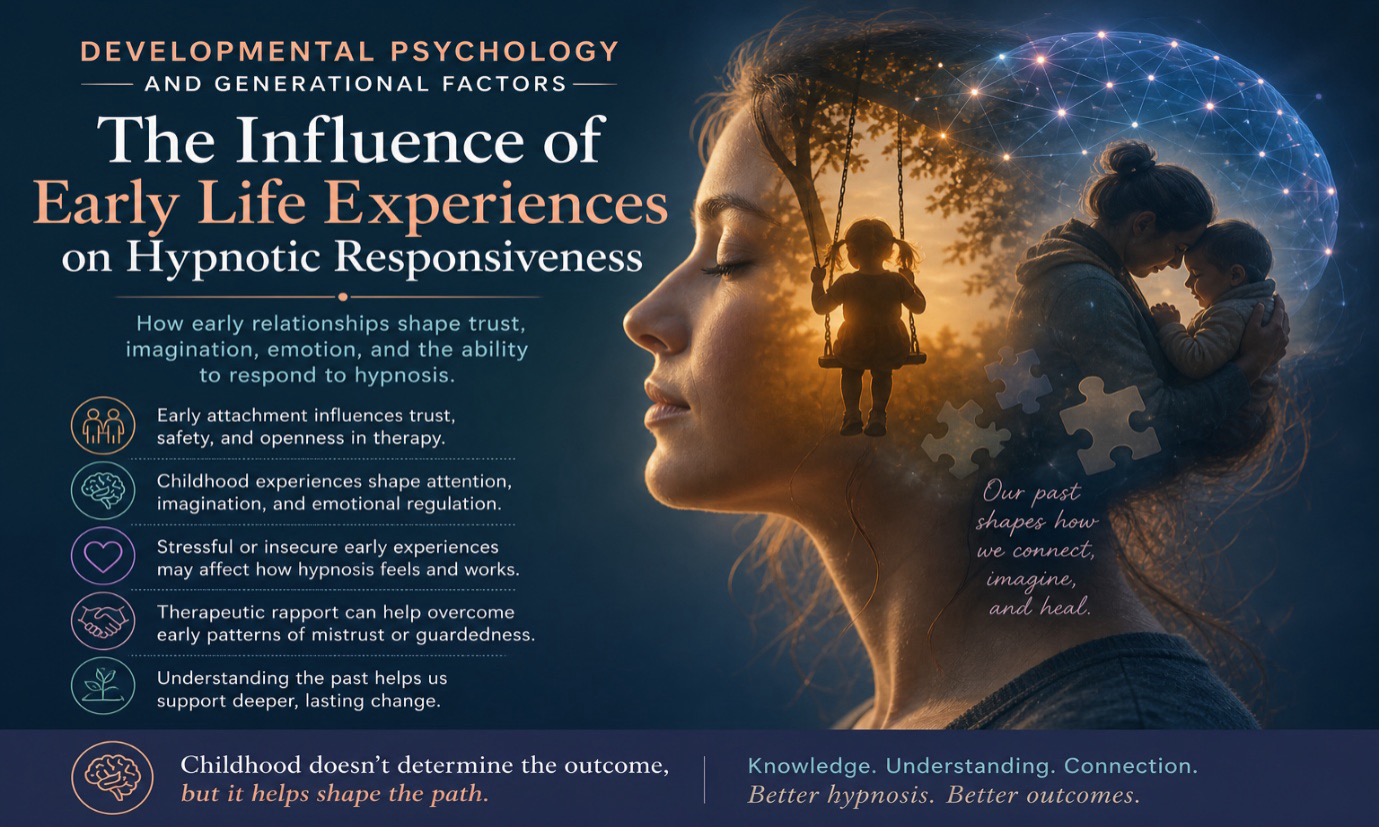
Developmental Psychology and Generational Factors
The influence of early life experiences on hypnotic responsiveness
In this new series we will look at how age impacts on hypnotherapy and its success. This time, we will look at how early life experiences can shape hypnotic responsiveness.
Research suggests that attachment patterns formed through early relationships with parents or other caregivers may affect how easily a person settles into hypnosis and how intensely they experience it. This field is still developing, and most studies are correlational rather than experimental. That means researchers can identify associations, but they cannot say with certainty that early experiences directly caused the hypnotic pattern observed. Also, hypnotic responsiveness is shaped by many influences besides childhood, including temperament, beliefs about hypnosis, attention control, and the immediate relationship with the hypnotherapist. In practice, these factors interact rather than act in isolation, and they will be unique to each individual.
Early life experiences appear to influence hypnotic responsiveness by shaping attachment, trust, self-regulation, imagination, and emotional response to the therapist. They do not rigidly determine who can be hypnotised, but they can meaningfully affect how hypnosis feels and how well a person can absorb and respond to suggestions. Childhood does not “switch hypnosis on or off,”; but it helps shape the psychological conditions that make hypnotic responding easier, harder, calmer, or more effortful.
Hypnotic responsiveness
Hypnotic responsiveness, also called hypnotisability, is the degree to which someone can respond to suggestions given in a hypnotic context. These suggestions may involve changes in movement, sensation, memory, or perception. People vary naturally in this ability, and the variation can change according to circumstances and the trust the client has in the therapist. Importantly, responsiveness is not the same as willingness to co-operate or simply “believing” in hypnosis. Our previous series on how the brain in affected shows that the experiences are real, not just the perception of the client.
Early relationships and attachment
One of the strongest early-life influences is attachment, which develops through repeated interactions with caregivers in childhood. Secure attachment usually comes from relationships that are reliable, comforting, and emotionally safe, whereas insecure attachment can arise when early relationships feel unpredictable, rejecting, or emotionally difficult. These early patterns tend to shape later expectations about other people, including whether closeness feels safe or threatening. In hypnosis, that matters because the experience often depends on trust, openness, and following another person’s guidance. If trusting authority figures is rooted in early experience, it is likely that the client will find it easier to trust a therapist and follow their instructions.
How childhood experience may matter
Early experiences may influence hypnosis through several psychological pathways. A child who grows up with encouragement to practice imaginative play, who is used to storytelling, and who has been encouraged to understand that other people may have a different perspective on events, may later find it easier to gain positive outcomes from hypnotherapy. They are likely to become mentally absorbed more easily and to experience imagery vividly; they will follow a narrative and be able to imagine an experience from a different point of view. By contrast, children who learn to stay guarded, self-protective, or highly watchful may later find it harder to relax, drop their guard, and enter the more focused, receptive state associated with hypnosis. Early stress or trauma may also affect how a person manages emotion and self-control, which can alter the quality of the hypnotic experience.
What the research shows
Human beings are complicated and it is not surprising that there is no simple rule about how childhood experience affects the experience of hypnotherapy later in life. The evidence does not support a simple claim that childhood experience directly makes someone highly or poorly hypnotisable. In one recent study, attachment style was not clearly linked to behavioural hypnotisability scores. However, it was linked to subjective features of hypnosis such as internal dialogue, absorption, and negative emotion. In that study, more insecure attachment was associated with less ability to focus and become deeply absorbed during hypnosis. Other research has also suggested associations between higher hypnotic susceptibility and childhood histories such as severe parental punishment, although we should remember that correlation is not necessarily cause. It is important not to be glib or overly simplistic. We should use this evidence as part of the rich tapestry of information we gather from clients rather than as a hard and fast rule.
Someone with secure early relationships may find it easier to trust the hypnotic process, stop over-monitoring themselves, and follow suggestions with less effort. Someone with more insecure or stressful early experiences may still be hypnotisable, but they may experience more inner chatter, more emotional discomfort, or less surrender to the process. In the hands of an experienced therapist, this resistance can be useful information and be used to inform the therapy.
Clinical implications
For therapists, the main message is not that difficult early experiences prevent hypnosis, but that they may influence how a person engages with it. A person with a history of insecurity, trauma, or chronic mistrust may benefit from a slower pace, clearer explanation, and stronger reassurance before hypnotic work begins. Someone with a more secure background may more readily enter absorption and benefit from standard hypnotic methods. This is why clinicians increasingly pay attention to rapport and the person’s subjective experience, not only to formal hypnotic test scores.
Get in touch
I hope this discussion has helped to clarify these ideas and perhaps sparked curiosity for further exploration. If you would like me to address a particular topic or expand on any aspect of this series, please feel free to get in contact.
Coming next
In the second of our series on Developmental Psychology and Generational Factors, we will look at addressing generational patterns through hypnosis.