




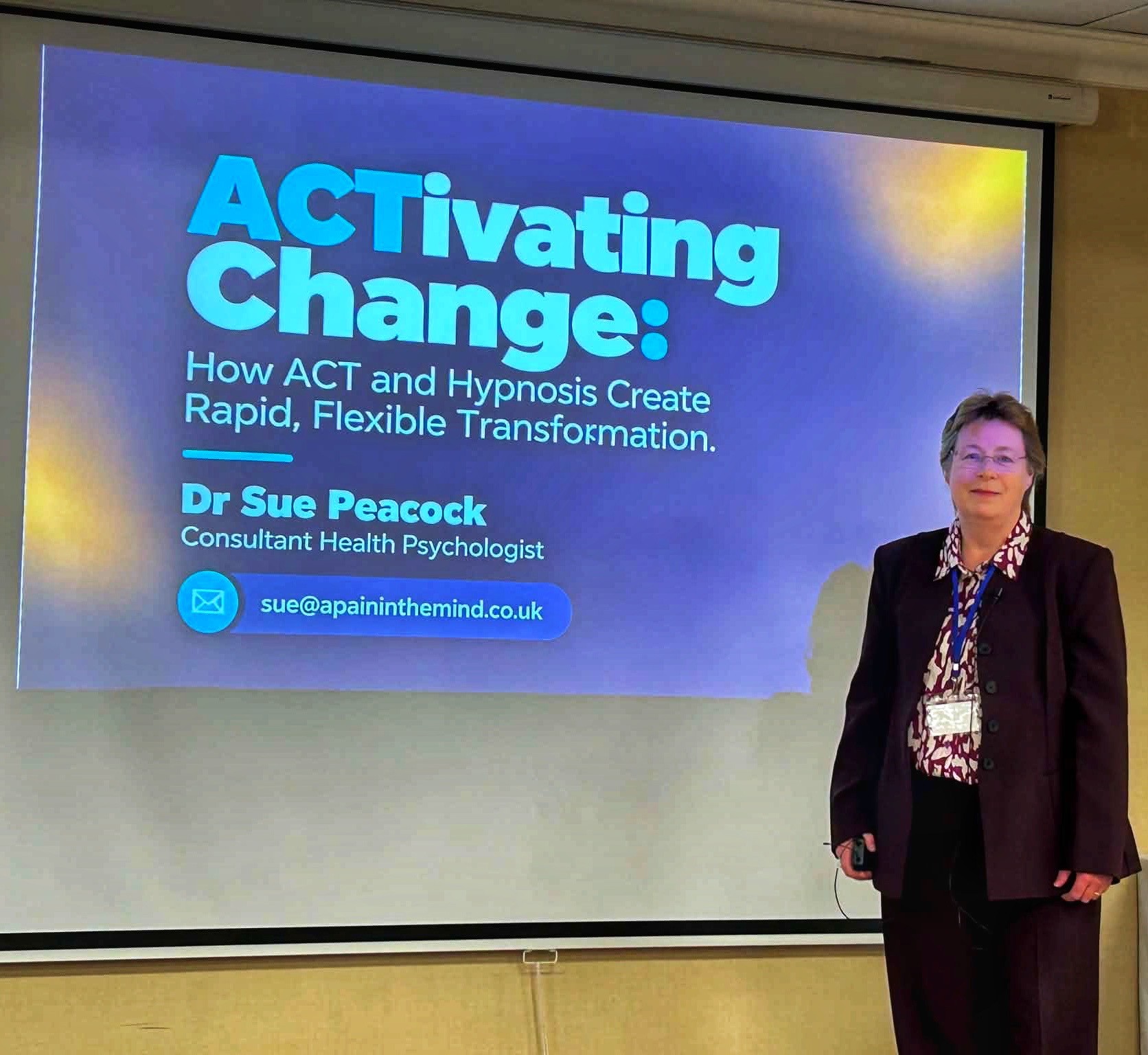
What if, as therapists, our desire to help people feel better is sometimes getting in the way of helping them live better?
It was a question I posed during my recent presentation at the UK Hypnosis Convention (UKHC), ACTivating Change: How ACT and Hypnosis Create Rapid, Flexible Transformation.
As hypnotherapists, we are often trained to reduce symptoms, eliminate unwanted emotions and replace negative thoughts with more positive ones. Our clients understandably want us to take away their anxiety, their pain, their fear or their distress.
But what happens when the very pursuit of feeling better becomes part of the problem?
This is where integrating Acceptance and Commitment Therapy (ACT) with hypnosis offers some fascinating possibilities.
The waiting room of life
In my clinical practice, I frequently meet people who have put their lives on hold.
- When my pain improves, I’ll start socialising again.
- When I feel more confident, I’ll apply for that promotion.
- When my anxiety disappears, I’ll start travelling.
- When I’m sleeping better, I’ll enjoy my life again.
They are effectively sitting in what I call the waiting room of life, waiting for their internal experiences to change before giving themselves permission to live.
The difficulty is that the harder we try to control certain thoughts, feelings and physical sensations, the more attention we may inadvertently give them.
Anyone who has tried desperately to fall asleep at three o’clock in the morning will recognise this paradox!
ACT invites us to ask a different question.
What would you be doing differently if you no longer needed to wait until you felt better?
Acceptance is not giving up
One of the biggest misconceptions about ACT is that acceptance means resignation.
When I introduce acceptance to someone living with chronic /persistent pain, they sometimes look at me as though I have suggested they should simply put up with it.
Nothing could be further from the truth.
Acceptance is about developing a willingness to experience difficult thoughts, emotions and sensations when doing so enables us to engage with what matters.
It is not about liking pain, approving of anxiety or abandoning appropriate treatment. It is about recognising that constantly battling our internal experiences can consume enormous amounts of physical and psychological energy.
Imagine what might become possible if some of that energy could be redirected towards living.
Where hypnosis comes in
Hypnosis provides a wonderful opportunity to move beyond an intellectual understanding of ACT and into an experiential understanding.
A client may understand perfectly well that thoughts are not facts, yet still respond to every anxious thought as though it were a reliable prediction of the future.
Through hypnosis, we can help clients experience a different relationship with those thoughts.
Rather than suggesting that unwanted thoughts disappear, we might invite someone to imagine their mind as a radio playing in the background. Sometimes it broadcasts helpful information; sometimes it repeats old stories, predictions and warnings.
The radio does not have to be switched off before they can get on with their day.
This illustrates cognitive defusion, one of the core processes of ACT. We are not necessarily changing the content of the thought; we are changing the influence it has over behaviour.
That seemingly small distinction can make a considerable difference.
Six processes, countless hypnotic possibilities
ACT focuses on six interconnected processes that contribute to psychological flexibility:
- Acceptance: Making room for difficult experiences rather than automatically struggling against them.
- Cognitive defusion: Learning to observe thoughts rather than becoming entangled in them.
- Present-moment awareness: Engaging with what is happening now rather than becoming consumed by the past or future.
- Self-as-context: Recognising that we are more than our thoughts, feelings, symptoms or personal stories.
- Values: Identifying what genuinely matters to us.
- Committed action: Taking meaningful steps in the direction of those values, even when discomfort is present.
Each of these processes lends itself to hypnotic imagery, metaphors, experiential exercises and carefully constructed suggestions.
For example, I particularly like the metaphor of the sky and the weather. Our thoughts and emotions are like changing weather patterns. Some days are sunny; others are stormy. Yet the sky provides the space in which all these experiences occur.
You are the sky, not the weather.
For someone whose identity has become dominated by chronic illness, anxiety or depression, experiencing themselves as more than their symptoms can be particularly meaningful.
What are our hypnotic suggestions actually teaching?
This is where I believe things become particularly interesting for hypnotherapists.
Consider these two suggestions:
“You will feel increasingly calm and confident whenever you speak in public.”
And:
“You can speak about what matters to you, even when you notice some anxiety.”
The first makes successful performance dependent upon a particular emotional state.
The second creates the possibility of successful performance regardless of that emotional state.
Both may be helpful, but they are targeting different psychological processes.
When integrating ACT and hypnosis, we need to consider the function of our suggestions, not simply how positive or reassuring they sound.
Are we helping clients develop greater psychological flexibility, or are we inadvertently reinforcing the belief that uncomfortable emotions must disappear before they can move forward?
Sleep is not a performance target
As someone who specialises in sleep difficulties, I see this issue repeatedly in people experiencing insomnia.
The more desperately someone tries to sleep, the more alert they often become. Sleep becomes another task to accomplish, another performance to measure and another opportunity to fail.
Traditional hypnotic suggestions might focus on falling asleep quickly and easily.
An ACT-informed approach might instead invite the person to experience being awake without treating wakefulness as a threat or a personal failure.
They might learn to notice thoughts about tomorrow without following them, to allow their body to rest without constantly checking whether sleep is approaching, and to relinquish the demand that sleep must happen immediately.
Interestingly, reducing the struggle with wakefulness may create conditions that are more conducive to sleep.
However, the therapeutic goal is not to turn acceptance into another clever technique for forcing sleep.
And that brings us to an important point.
Don’t turn acceptance into another control strategy
One of the potential pitfalls of integrating ACT and hypnosis is suggesting that if clients accept their discomfort, it will disappear.
“If you accept your anxiety, you will become calm.”
“If you stop fighting your pain, it will go away.”
These suggestions may sound appealing, but they risk undermining the very principles of ACT.
Acceptance becomes conditional. The client is still attempting to control their internal experience, just through a different strategy.
Of course, symptom reduction may occur, and we can welcome it when it does. But psychological flexibility means that meaningful living does not have to depend entirely upon it.
Moving towards something, rather than simply away from something
One of my favourite questions to ask when developing a therapeutic intervention is:
What is my client trying to move away from, and what could they move towards?
A person experiencing chronic /persistent pain may want to move away from discomfort, frustration and fear. But perhaps what they really want to move towards is connection, independence, creativity or a renewed sense of purpose.
Someone experiencing social anxiety may want to escape embarrassment, but what they value is friendship and belonging.
Hypnosis can help clients reconnect with these values, mentally rehearse meaningful actions and explore what taking the next small step might look and feel like.
We are no longer simply helping someone escape an unwanted experience. We are helping them build a life that feels worth engaging with.
A different measure of therapeutic success
Perhaps we need to broaden how we define successful therapy.
Rather than only asking:
“Has your anxiety reduced?”
“Is your pain less intense?”
“Are you feeling more confident?”
We might also ask:
“Are you doing more of what matters to you?”
“Are your thoughts making fewer decisions on your behalf?”
“Is your life becoming bigger, even if some of your difficulties remain?”
Integrating ACT and hypnosis does not mean abandoning symptom-focused interventions. It means expanding our therapeutic repertoire and recognising that there is more than one pathway to meaningful change.
For me, this integration represents an exciting opportunity to bring together the experiential power of hypnosis and the psychological depth of ACT.
And perhaps the most important message from my UKHC presentation was this:
We don’t always have to change what our clients feel. We can change what becomes possible.
Now that really is worth thinking about.